Showing posts with label 1980s. Show all posts

Somewhere Angels in Heaven are Crying

RAIN ON ME - The Clams

The Village Voice's influential Pazz & Jop was an annual poll of music critics compiled by Robert Christgau.  In the 1984 edition, three acts from the Twin Cities appeared in the top ten:

Minneapolis music was at its commercial and critical peak. 1985 saw the debut of The Clams, a hard rocking band inspired by the likes of the Rolling Stones and the New York Dolls. Singer/guitarist Cindy Lawson's ad in a couple of alt-weeklies looking for women who wanted to play bluesy rock caught the attention of lead guitarist Roxie Terry, bass player Patsy Joe, and drummer Karen Gratz.  Soon, they were playing at the Uptown Bar, 7th St Entry, and other popular local venues.

While The Clams didn't go on to major commercial success, they were a popular live act. They released an LP in 1988, "Exile on Lake Street" - five years before Liz Phair's seminal "Exile in Guyville" album and 16 years before the band Lake Street Dive named itself after the same Minneapolis street.


Their most memorable live show took place not in a dive bar or rock club, but in prison.  Located 25 miles east of Minneapolis, the state correctional facility in Stillwater opened in 1914 and is listed on the National Register of Historic Places.  In 1987, The Clams put on a concert there for the inmates. 

Before you read the interview with Cindy Lawson below, head on over to Vimeo (Rain on Me - The Clams) where you can see the band perform a number of songs at the prison.

The Clams at Stillwater Prison

1 - How did The Clams end up playing a gig at Stillwater prison and - since we don't get to see the audience in the video - what was the atmosphere like?

Cindy Lawson - I don't know if they still do this, but back then the inmates would do a 'carnival' annually in the summer to raise money for Muscular Dystrophy. Bands played inside an auditorium, then in the courtyard they had a dunk tank (which of course we went in!) and food trucks. 

I believe we learned about this gig from a band we knew, Big Mambo, whose drummer was Tom Cook. We went in a week or two before to do a video interview with the two gents who were in charge of the bands. I think I have a copy of that somewhere-we were unbelievably silly (as we always were) so I look back and appreciate their patience with us!

The audience (the inmates) were extremely well behaved. There wasn't any shouting or dancing-so unlike a bar gig! They were very appreciative and applauded like crazy after each song and then quieted down. I'm sure there was a mandate set forth that in order for them to have fun privileges like bands and carnivals they needed to be on their best behavior. We never felt scared or worried about any of it. None of them really came up afterwards to talk to us-the only ones we communicated with (besides the prison personnel) were the two inmates I mentioned before.

Inside Stillwater Prison

2 - Did your mom really tell you, "When skies are cloudy, somewhere angels in heaven are crying?" 

CL - Yes, I think that was one of hers. Along with "Don't eat raisins in the dark." 😁 But she never said "Powder your nose and kick some ass" that I attributed to her on our EP. That one's mine. 🤓

3 - Your intro quotes the Blues Brothers line, "We like both kinds of music, country and western."  You also performed Johnny Cash's Folsom Prison Blues" (appropriately) at this show.  Did you listen to much country music at the time or was this simply a Stones inspired bluesy song?

CL - We listened to real country-Loretta Lynn, Patsy Cline, Dolly Parton, Johnny Cash. That music is universal. 


4 - Do you still have that guitar?  Or the Rickenbacker (which I like a lot) that you also played at this concert? 

CL - I don't have the Squier anymore. My first boyfriend (and all-time best friend, Nic Santiago) gave it to me as a birthday present. The Rickenbacker sadly disappeared at some point during the '90s. I tried to find it but never could. I have a hunch who the thief was, but could never prove it, and if he really wanted a guitar that bad, so be it. I only hope he played it and didn't sell it for drugs.

5 - Have you ever run into an ex-con who said," I remember you from that show when I was in the Big House," so to speak?

CL - I haven't, but I remember one of the two inmates who were in contact with us contacted Roxie when he got out just to say hello. And someone from the prison sent her a special leather belt they had made. She had a lot of fans! 

Minnesota Correctional Facility - Stillwater

6 - You say in the clip that you and Roxie just wrote "Rain on Me."  Was one of you more the lyricist and the other more the music, or was it 50/50 in all respects?

CL - She definitely wrote the music and I wrote the words. I didn't start writing melodies on guitar until later. 

7 - Any other thoughts or feelings that seeing this clip now evokes?

CL - Well, thank you so much! This is delightful! I miss those ladies and I certainly miss that time in my life. I still see Karen and Patty (who lives in Lake Tahoe) often. We were so young and had so much fun. It's sad that one never appreciates the time they are in until it's long gone. And we certainly didn't archive things very well. I have no idea how some of our videos end up on the web and then are mysteriously taken down.  

Where No Doctor Can Relieve Me

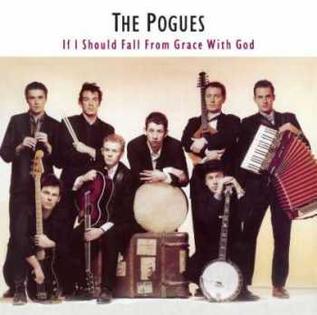
"If I Should Fall From Grace With God" - The Pogues' James Fearnley


While on a long drive recently, I stumbled across a compelling interview on NPR.  The fascinating fellow telling tales of rock and roll turned out to be James Fearnley, accordion player for and founding member of The Pogues.  It turns out that earlier this year his book "Here Comes Everybody: The Story of the Pogues" was published.  Believe me, if you heard the interview, you wanted to get the book as soon as possible.

I don't recall the first time I heard the Pogues, but very few people I knew were aware of the band. They were much bigger in the UK than they were in America.  But I was drawn to their unique blend of rock, celtic, punk and world music.  Their recordings from the late 1980s and early '90s have held up very well as a result of following their own muse and incorporating traditional elements, rather than chasing whatever sound was au courant.

I reached out to James and he kindly agreed to answer my questions.  The hard part was picking which song would be the subject.  "Fairytale of NY" gradually became a favorite of the musically hip here in the US; it's a Christmas song and this is the holiday season; and I find the song completely amazing even after many hundreds of listens.  But it felt like well-trod ground.

So I chose "If I Should Fall From Grace With God," the single that followed "Fairytale," for its mix of infectuous music and dark lyrics.  Take a listen; the Q+A follows.

IF I SHOULD FALL FROM GRACE WITH GOD - THE POGUES

1 - Do you recall your impression of "If I Should Fall From Grace With God" in whatever state it was in when Shane (McGowan) first played it for you?

James Fearnley:  It was during rehearsals in January 1987 that I first heard ‘If I Should Fall From Grace With God’, along with ‘Rake at the Gates of Hell’, both of which he would probably have written anyway, but each earmarked for inclusion in the soundtrack for Alex Cox’s film, ‘Straight To Hell’, which had been shot, in Spain, the previous summer. 

Both songs, musically speaking - the way we went about them anyway - relied on a kind of propulsive, swampy (aptly enough for the choruses of ‘If I Should Fall From Grace With God’, with their images of rivers and mud), Mississipi Delta shuffle, with elements of Cajun music, even though the band hadn’t actually visited the South at that time. 

Both songs seemed fairly complete by the time Shane introduced them to us, structurally. I had always enjoyed the powerful statement of a melody which could basically stand alone, reiterated in the middle, and as a finale to the song, following the sort of template the Pogues, in conjunction with Shane’s songwriting, had developed in the course of the previous couple of years, and as early as ‘Streams of Whiskey’ and ‘The Dark Streets of London’. 

I’ve written about the opening melody of ‘If I Should Fall From Grace With God’ in ‘Here Comes Everybody’, and how it bore similarities, for me, to ‘The Bonny Banks of Loch Lomond’. I remember adoring the melody - it’s pentatonic scale expansive and ancient, and carrying with it the theme, as in ’The Bonny Banks of Loch Lomond’, of the proximity of death. I wouldn’t have acknowledged, at the time, the narrator’s beseeching ‘Let me go, let me go’, to have been particularly significant, as such appeals became more urgent a couple of years later.

2 - You played a variety of instruments on the IISFFGWG album - grand piano on "Fairytale of New York," a mandolin, a dulcimer which you hammered with teaspoons, etc.  Did you play anything in addition to accordion on the title track? 

JF:  Recording studios have always been a toy box for me, particularly during the recording of 'If I Should Fall From Grace With God’, with Steve Lillywhite in May 1987, and particularly on ‘Fiesta’, when it came to replicating gunshots by means of my mouth, among other things. A few years before, I’d spent quite a long period listening to Spike Jones and His City Slickers. I used to know the drummer from a band called the Vibrators. We’d get the saucepans and lids out from my kitchen, and a couple of spoons each, and 'play' along with dance bands from the 1930s - Ray Noble and Al Bowlly were favourites. 

When it came time to record the demos for a large part of what turned out to be the album 'If I Should Fall From Grace With God’ (’The Terry Woods Solo Album’, which, for ‘contractual reasons’ had to be kept secret), for ‘Fiesta’ there were metal ashtrays and other similar percussion instruments around the penthouse studio at Abbey Road. Otherwise, I remember sawing away at a cello on ‘Turkish Song of the Damned’, and being summoned to the studio by Lillywhite to add a bit of ‘sizzle’ to ‘Bottle of Smoke’, by means of a cymbal laid flat on the floor and beating out triplets on it with sticks. 

I think the hammered dulcimer came later, once I’d realised there was an instrument that sounded better than laying a mandolin on my lap, damping off the strings I didn’t want by means of cardboard stuck between them, and laying into it with teaspoons. The break in ‘Haunted’ (to Philip Chevron’s chagrin, because I rather think he would have liked the opportunity to play a guitar solo), which we recorded a year earlier, is done that way.

3 - Why did the band choose to name the album after this track?

JF:  Frank Murray, our manager, was vexed that we hadn’t come up with an album title. ‘Red Roses For Me’ had come so immediately and simply. I wonder if Shane knew all along what he wanted the title of our first album to be. ‘Rum Sodomy and the Lash’ became obvious, from Andrew Ranken’s navy stories - though I’m glad the album wasn’t called ‘Dance of the Flaming Arseholes’, which was one of Andrew’s most memorable stories. ‘If I Should Fall From Grace With God’ proved to be not so easy. Nothing ever spontaneously raised its head. Murray, with his back against some sort of wall, burst into our rehearsal, wanting an album title. Shane just shouted back "‘If I Should Fall From Grace With God’!”  to make him go away.


4 - IISFFGWG was used in a 2010 Subaru commercial about hockey moms.  Could you ever have envisioned this back in 1988?

JF:  No. Neither could Iggy Pop have envisioned ‘Lust for Life’ in a commercial for Royal Caribbean cruises.

5 - An earlier, slower version of IISFFGWG was released on the soundtrack for "Straight to Hell" in 1987.  Why did the band decide to revisit/redo the song?

JF:  There’s no gripping story to this. The song, with ‘Rake at the Gates of Hell’, was recorded for the ‘Straight to Hell’ soundtrack. There was some foot-dragging on our part, vis à vis our relationship with Stiff Records, and we were eager to record. After our summer holidays in the Tabernas Desert outside Almerìa there was a lot of energy in the band, musically. ‘If I Should Fall From Grace With God’ and ‘Rake at the Gates of Hell’ were part of that energy. ‘Rake at the Gates of Hell’ should have been a contender for the record had it not been for the malevolence of the lyrics. Shame.

6 - How disappointed were you, or not, when IISFFGWG peaked at #58 in the UK after the previous single, "Fairytale of NY," was a #2 hit? 

JF:  ‘Fairytale of New York’ hit a nerve that was always going to remain hidden from ‘If I Should Fall From Grace With God’, I suppose. Christmas in the United Kingdom (in perpetuity, it seems) was ready for ‘Fairytale of New York’. Easter not so much for ‘If I Should Fall From Grace With God’. (I think I’m right in saying that the single of ‘If I Should Fall From Grace With God’ was released around Easter 1988.)

7 - What is your most memorable live performance of IISFFGWG?

JF:  All performances of ‘If I Should Fall From Grace With God’ have tended to run into one collective one. It has been a favourite of mine to play, since we first started playing it. It provides me one of the first opportunities in the set to throw the bass end of the accordion skyward and drag the keyboard end down towards me for the last chord. If there’s any performance or series of performances I particularly remember, they were for the video we recorded at the Town and Country in Kentish Town during the week of St Patrick’s Day 1988. Philip Chevron was masterful in front of the cameras. I had no idea what to do and learned a lot from him. Not much of a memory, it’s true, since it forms part of that residency we had, and in our stamping ground, in our home town, at the end of a tour of the UK, not long after coming back from the other side of the world after our first tour of Australia. It was good to be back at home.


For other interviews James has done, see the links at this page on his website.

I'm Shouting All About Love

All Those Years Ago - George Harrison (Al Kooper on keyboards)

Hit the "play" button in your mind and listen to "All Those Years Ago," George Harrison's 1981 tribute to John Lennon. As with songs, the vocals are most prominent in memory. Then what do you hear? Probably George's unique slide guitar. Next? That great keyboard part. Who's playing it? Al Kooper.


George, Ringo, Barbara Bach, Al Kooper
Photo © Al Kooper


Now, the people I've interviewed for this blog have all been very kind and each one is an accomplished and talented musician. But Al Kooper is a whole other level. Initially I was going to list his career highlights, but it was way too long. Then I pared it down to the highlights of his highlights and it was still a bit long. So I cut it down once more to produce what appears below.

Besides his work on a song featuring three Beatles, he also:
  • Played the fantastic organ part on one of the milestone songs in pop music history, Bob Dylan's "Like a Rolling Stone." The story of how this came to be is a great one; he recounts it memorably in Martin Scorsese's documentary "No Direction Home." Kooper also played with Dylan at the infamous 1965 Newport Folk Festival. 
  • Speaking of stones that roll, Kooper played the piano, organ and french horn on another 1960s masterpiece, "You Can't Always Get What You Want." 
  • He founded the innovative jazz rock band Blood Sweat & Tears - only to be kicked out by the other members, who wanted to pursue Top 40 hits (which they accomplished). 
  • At age 21, co-wrote the #1 pop hit "This Diamond Ring" by Gary Lewis & the Playboys. 
  • He discovered Lynyrd Skynyrd, signed them to his Sounds of the South label, and produced their first three albums (which included "Free Bird" and "Sweet Home Alabama.") 
  • Wrote the book Backstage Passes & Backstabbing Bastards: Memoirs of a Rock 'N' Roll Survivor and played in the Rock Bottom Remainders with other authors (Stephen King, Amy Tan, Matt Groenig, Dave Barry, etc.). 
  • Was a faculty member at Berklee College of Music in Boston. 
  • Released a dozen solo albums and landmark LPs with Mike Bloomfield and Stephen Stills. He sings, plays keyboards, guitar and more. 
  • Scored Michael Mann's Crime Story series, among other film and television work. 
And so on and so forth. Google him for more details. A personal favorite of mine is his production of the live Joe Ely EP, "Texas Special."

I am happy to report that Al cheerfully answered seven questions about "All Those Years Ago."

George Harrison is recording a heartfelt song about John Lennon not long after John's murder. He thinks, I need to have these guys perform on it: Paul, Ringo... and Al Kooper? Pretty elite company. How did the gig come about?

Al Kooper: I was living in London. I was best friends with bassist Herbie Flowers who I worshipped as a musician at the time. I played with him as often as I could. He got called for the Harrison sessions and suggested George hire me as well. George didn't know I lived there and was a large Dylan fan so I got the job. 

We were recording an entire album, plus some tracks for Ringo's album that George was producing. We cut a version of ATYA before John died, but it had an alternate lyric. John died while we were naking the album. George rewrote the lyric and recorded a new vocal to the track we had already cut.

And then had Paul, Linda and Denny Laine come in and add backing vocals. George supposedly wrote the song for Ringo to sing - this was before John died, so it had different lyrics - but Ringo wasn't keen on it. Did you ever hear the original version?


Photos © Al Kooper


AK: I think that is not so. I don't think it was for Ringo's album, but rather George's. But it did have another lyric based on the title. 

Your part is very prominent in the mix. Did George give you much direction or did he leave it up to you to create what you felt was right?

AK: All the tracks we cut were just jammed. We were all experienced studio players and that's the way we played. George sang live so I knew where to play fills.

Did you record any alternate versions or just the take we all know?

AK: We played it until George thought we had a good take.


Photo © Al Kooper

You recorded this at Friar Park, George's home. What was that like? 

AK: It was very comfortable and it was great to see his guitar collection.

Did you know Lennon?

AK: I did know Lennon. Mostly when we both lived in LA. A bunch of us used to record and hangout at The Record Plant studios.

When I was producing (Lynyrd) Skynyrd's second album, John came in during a session to ask me something. He stayed for two minutes then discretely left.

The band were all out in the studio. Lennon had come into the control room.

When he left Ronnie Van Zant said: Was that John Lennon who just came in?"

I said "Yeah."

Ronnie said " We have to take a break for a few minutes." It blew their southern minds!

How do feel the song holds up since it was recorded all those years ago, pun intended?

AK: a) I have never been so loud in a mix on someone else's record
b) I am very proud of what I played on the fly
c) It was a #1 record in Billboard
d) For me, it holds up great