Showing posts with label theme song. Show all posts

Who Can Turn The World On With Her Smile?

"LOVE IS ALL AROUND" (The Mary Tyler Moore Show Theme Song) -- Sonny Curtis


Singer, songwriter and guitarist Sonny Curtis played with Buddy Holly, wrote the rock anthem "I Fought The Law" and is a member of the Rock and Roll Hall of Fame.

Oh, and he also wrote one of the most iconic and beloved television theme songs ever. Yes, I am biased because I was a kid growing up in Minneapolis (where the sitcom was set) when the series originally aired; watching the opening credits now is as familiar and comforting as viewing a home movie... but I dare you to play this video and not sing along:


Sonny was kind enough to answer my questions about "Love is All Around" via email:

1 - I've read about how you got word one day that a sitcom needed a theme song, so you came up with one quickly and then went over and played it for the producers, who bought it immediately.  When they recorded the version used for the series, did you just record your voice and guitar or were you also involved in the arrangement with the strings and brass, etc?

Sonny Curtis: My friend Doug Gilmore worked for the Williams/Price Agency, who managed Mary Tyler Moore. He called one day about 11 AM and told me about the plan for a sitcom with Mary. During his lunch break, he dropped off a small synopsis that described Mary's character and what the show was about. I wrote the song in about two hours, called him and said, "who do I sing this to?" He sent me to James L. Brooks, the show's executive producer. I sang him the song and he liked it.

I was not involved in the arrangement. Pat Williams arranged the song and I sang on it at the session.

2 - Why did they tweak the song after the first season?

SC: The lyrics for the first season started with "How Will You Make It On Your Own," etc. After the first season, James L. Brooks called and said, "She's obviously made it, so we need to up date the lyrics." I did a complete rewrite and we recorded it again with a different arrangement, also by Pat Williams. I played the acoustic guitar lick on that version and overdubbed my lead vocal.  

3 - Did your success with "Love is All Around" land you any more theme song work?

SC: I wrote two other TV themes: Szysznyk and Evening Shade. Whether the MTM theme had anything to do with it, I don't know. Although, because I sang the MTM theme, I got a lot of work singing jingles.

4 - If the producers hadn't been interested in the song, what do you think you would have done with it?

SC: I don't know. I guess I would have tried to pitch it to some artist. Without it's exposure on the show, though, I wonder if it would have had commercial value. I guess we'll never know.  

5 - "LIAA" has been covered by everyone from Joan Jett to Sammy Davis, Jr. to Minneapolis' own Husker Du.  Do you have a favorite cover version?

SC: I like them all. One thing, it provided me with the opportunity to meet and hang out with Sammy Davis, Jr. for a while, which I'm proud of. He called and invited me to his palatial hotel suite to go over the song and the music with him. It was a real pleasant experience.

I guess if you pinned me down, I'd have to say Joan Jett's is my favorite.

I actually like the version we did for the show. Not because I sang it, but I think the arrangement is perfect.
 

6 - Do you have a theory about why this particular song struck such a chord with viewers and listeners and has endured for all these years?

SC: I think the timing was great. It was sort of at the beginning of Gloria Steinem's feminism movement and I think the show was a touchstone for that period. Mary, Rhoda, Phyllis, Lou, Ted and the rest of the cast were fantastic. It had terrific writers and outstanding production. I think great synergy was created by doing it in front of a live audience.

The show has enormous staying power, thus the song has great staying power. Whatever the reason, I'm very proud that I was fortunate (and lucky) enough to be associated with such a wonderful part of television history.
 

7 - What is your favorite television theme song or one you wish you had written?

SC: I'm a great fan of music and I probably shouldn't go down this road. There are so many good ones written by magnificent composers. I'm sure I'll leave out quite a few, but I'll give you an example of some of my favorites. I love the themes from M*A*S*H, Cheers, and the first Bob Newhart Show. And way high on my list is Welcome Back, Kotter , written and performed by one of my all time favorites, John Sebastian of The Lovin’ Spoonful.  

Many thanks to the talented and humble Sonny Curtis for the interview. Check out his official website here.

Talking Baseball Every Week

"GLEEMAN AND THE GEEK" THEME -- John Bonnes


I've posted about theme songs for television ("Justified") and film ("We'll Never Have Paris"), but never for a podcast.  Until now.

Gleeman and the Geek are not the next Sonny & Cher or Hall & Oates or DJ Jazzy Jeff and the Fresh Prince.  They are not musicians at all.  John Bonnes and Aaron Gleeman, among the first bloggers to cover the Minnesota Twins baseball team, are the voices behind a very popular Twins podcast.  

I'm not a big believer in the importance of "chemistry" in the clubhouse, but it's everything in a podcast.  And GATG have more chemistry than anyone this side of Walter White.  Whether recoring at KFAN studios or at a local tap room, they bring insight and humor in equal measure.

YMMV.  But City Pages agreed with me when they did their "Best Of" issue last year.

Check out their podcast if only to listen to the theme song before John answers seven questions about it below: Gleeman And The Geek Podcast

As any good theme song should do, the GATG theme sets the right tone every week at the top of the podcast.  It's catchy, to the point and lively; the guitar and vocals are fun; and the drums during the outro are the perfect lead-in to John's signature "...aaaaaaand welcome!"  Starting without this sequence would be like beginning a ball game without "...and the home of the brave - play ball!"

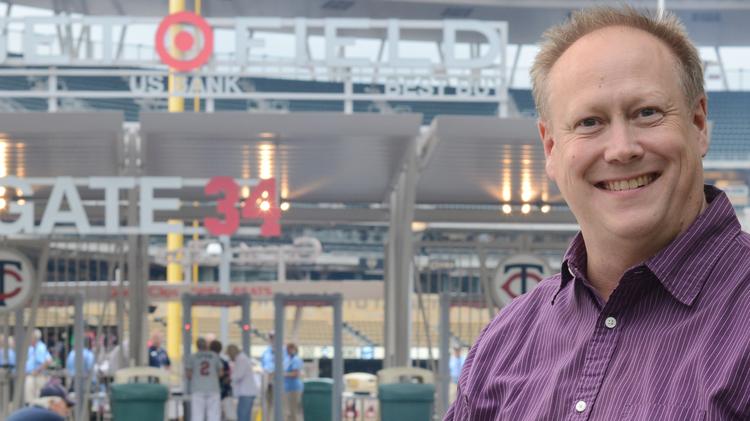
John Bonnes

1 - Why did you want to have a theme song for the podcast?
 
John Bonnes:  For the first couple, we didn't, I don't think. But when listening to a podcast it really helps to have some music at the beginning, so we put out a plea and it was answered.
 
2 - Who wrote and performed the GATG theme?
 
JB:  The original was by James Richter. It was super simple and we used it over and over, and you can still hear the gist of it at the end of our podcast, because he did a "footer" sound bit for it, too.

James Richter - Not how I imagined him based on his singing

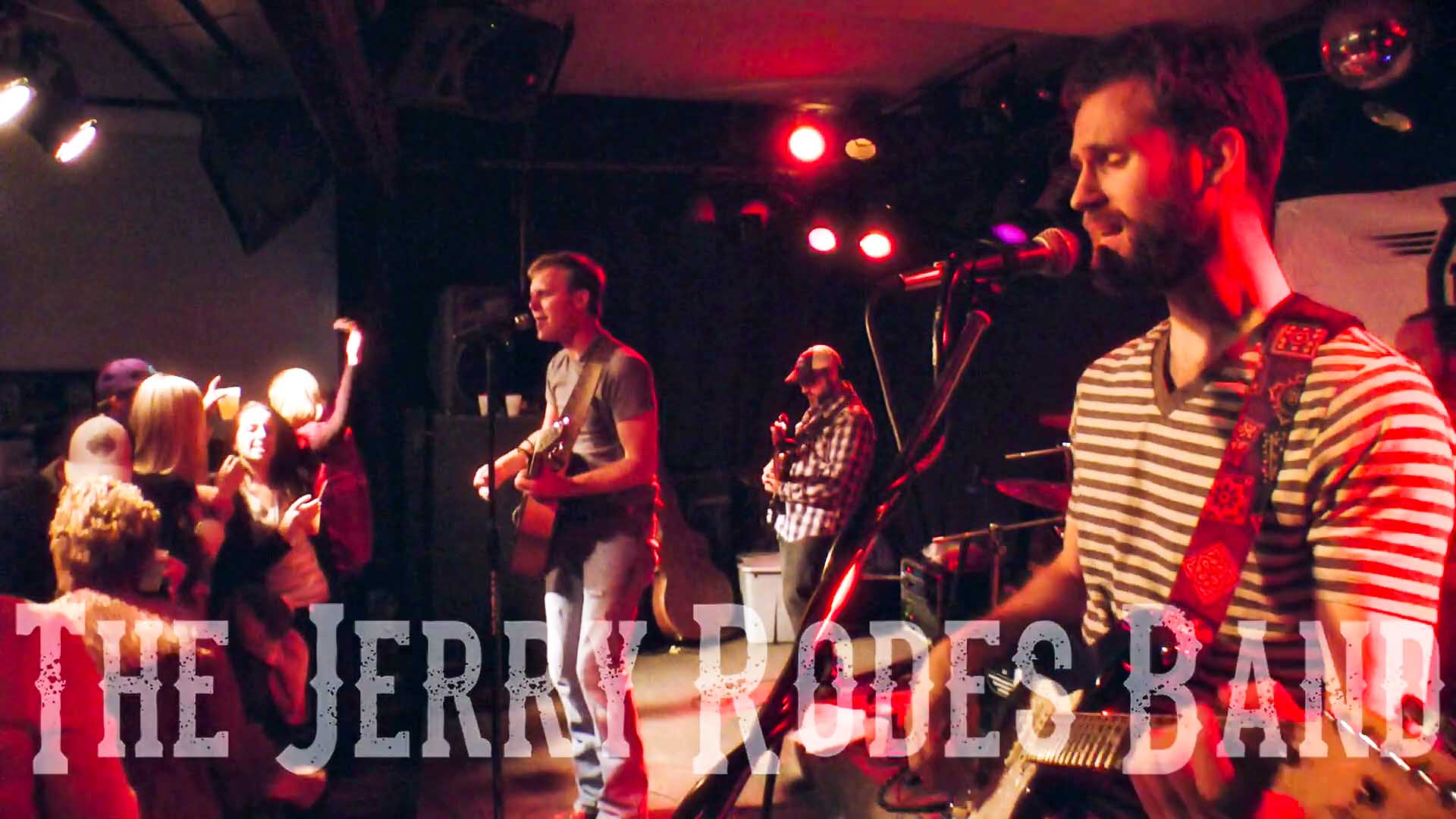
And then, a few months in, another band, Jerry Rodes, did one. So we went back and forth between them for them for a long time. At some point, we needed to pick one for KFAN, and we went with the Jerry Rodes one, and so then we stuck with that one during the offseason, too.
 
 
3 - How long did you have to practice to perfect your Angela Lansbury voice for your (excellent) reworking of "Beauty and the Beast"?
 
JB:  :-) I was actually going to have my kid sing it, but she sounded too good, and I wanted it to sound kinda stupid, so I recorded it as over-the-top as I could.  Not too many people know about that song, I don't think.  I don't think we've played it on the podcast more than once or twice.  Aaron hates it.
 
4 - Do I recall correctly that (besides the two versions we've discussed) there was at least one other alternate version?
 
JB:  This question made me look some up. 

I think the alternate version that you're talking about might be the original version by Richter.  Long time listeners will recognize it for sure.

But there also was another alternate "sexy" version which we only played a couple of times.  I've tried to find who created it, but I can't find any record of it.  I still do have the clip of it.

There is also a 2nd version that James Richter also did in a completely different style - the secret "John Mayer" version.
 
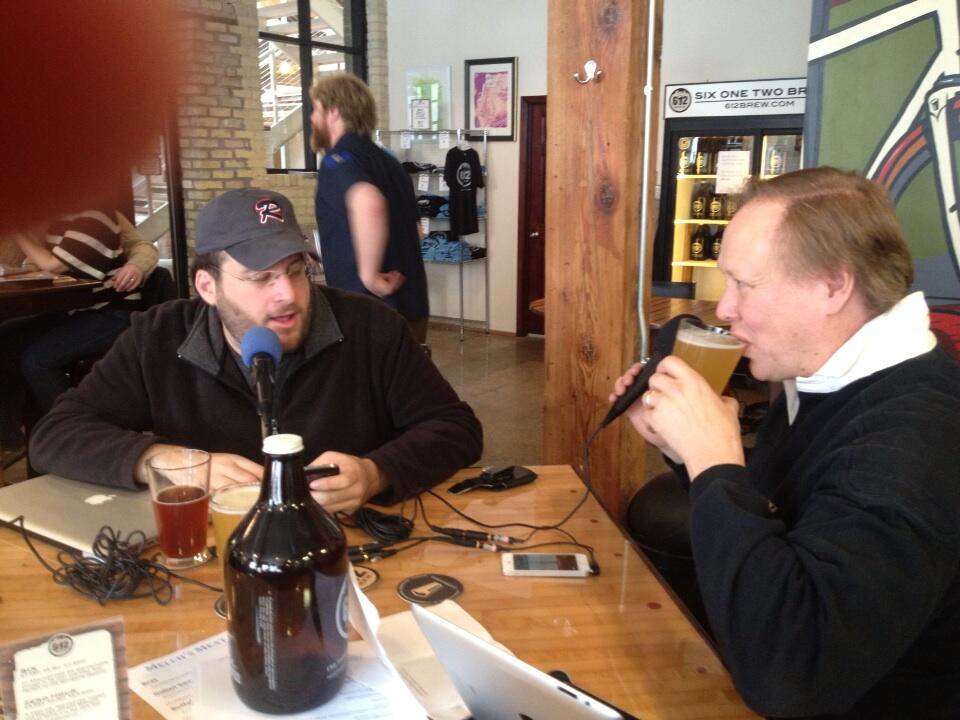
"Gleeman and the Geek" recording a podcast

5 - Didn't Gleeman have some teenage girl in New Zealand working on a new theme song (and I assume she wasn't Lorde)?
 
JB:  Yeah.  I'm kind of forgetting the details.  I think she did send something. But she didn't really know anything about baseball and so some of the words sounded like a foreigner trying to use baseball slang, so I think Aaron asked for a couple of changes and then we never heard back.  But I could be making a lot of that up.
 
6 - Was there any thought about calling yourselves "The Geek and Gleeman"?
 
JB:  No.  Gleeman and the Geek flows a lot better.  We sometimes joke about that.
 
7 - What is your favorite podcast theme song, aside from your own?
 
JB:  I don't listen to a ton of podcasts. My favorite custom one is a groovy one for the Talk to Contact. "Twin brothers talking Twins baseball....."
 
I also LOVED the song "Panama" by Van Halen in my youth, so I love it when The Sportive uses that to kick off their show.  And No Juice has that great instrumental that was used for some sports show in my youth.  I think that is a great beginning.
 
********

You can find GATG on Twitter: @twinsgeek @aarongleeman @gleemanandgeek

John manages and sometimes writes for twinsdaily.com, a popular site he co-founded in 2012.

SHOUT A HIP-HOORAY

We're Going to Win, Twins - Mary Jane Alm

If you grew up in the Upper Midwest, these words should be familiar:

We're gonna win, Twins
We're gonna score
We're gonna win, Twins
Watch that baseball soar.
Crack out a home run
Shout a hip-hooray
Cheer for the Minnesota Twins today.
 
This song has been around since the Washington Senators moved to Minnesota and became the Twins in 1961.  It's played when the team takes the field for home games.  It was (and maybe still is) used to kick off radio coverage of Twins games.

The song was initially intended not for the baseball team but for one of its sponsors, Hamm's Beer:

Sing out for Hamm's beer,
Sing out the name,
Sing out for Hamm's beer,
Of sky blue waters fame
 
I can't determine if that version ever aired.  I'm assuming not, since the Campbell Mithun advertising agency sold the tune to the Twins for a dollar.  Ray Charles (not the one you're thinking of) revised the words to the tune Dick Wilson had composed.  The Ray Charles Singers (not the Raelettes) sang the fight song and it blasted from AM radios every summer for the next few decades.
 
Side note: Hamm's didn't need the tune, since it already had a very catchy "From the Land of Sky Blue Waters" song that was featured for many years in popular commercials like this one:
 

The Twins have updated the theme song a couple of times.  The best known version, the one played as players take the field, is sung by two men and two women, and I didn't realize until recently that one of those voices belonged to Mary Jane Alm.  She was and is one of Minnesota's best known and beloved vocalists.  The Mary Jane Alm Band and its leader never broke out nationally, but regional fame eventually led to Alm's induction to the Minnesota Music Hall of Fame in 2013.


maryjanealm.com

I was able to catch up with Mary Jane Alm and quiz her about her experience as a vocalist on "We're Gonna Win Twins." 

1 - Are you even a baseball/Twins fan?
 
Mary Jane Alm:  I am a longtime Minnesota Twins fan.  I grew up in southern Minnesota and my dad took my brothers and I to the big city to see the Twins many times growing up.  We started going to games when the Twins played at Met Stadium.


2 - How did you get the gig singing on "We're Going to Win, Twins"?
 
MJA:  I was one of the first call session singers back in the '80s and '90s along with the other singers on this song, Kathy Mueller, Scott (Scooter) Nelson and Steve McLoone.  We got hired for all the biggest radio and television spots that were produced in the Twin Cities...  And this was one of them. 

Scott "Scooter" Nelson of the Mary Jane Alm Band

3 - The Twin's bought the song for $1.  I'm hoping you got more.  Not to pry into your finances, but was it a flat fee or do you get residuals... or free entry to Twins games... or anything?
 
MJA:  I can't quite remember how much money I made but I do know that it was a flat fee...  No residuals, no free baseball games or Twins memorabilia.
 
4 - Have you ever sung the song since the recording?
 
MJA:  The four of us got to sing the Twins song and the National Anthem at a baseball game following the release of the song.  We did get great seats to see the game that day and got to meet some of the players.
 
5 - Did you help with the musical or vocal arrangement or were you hired strictly to sing your part?
 
MJA:  We were hired strictly as singers... We had nothing to do with the writing or arranging.
 
6 - How familiar were you with the original, 1961 version of the song?
 
MJA:  I was very familiar with the original theme song.  Everyone who grew up in Minnesota knew the song by heart!!


7 - You actually have twin sons, right?  Was that karma?
 
MJA:  I do have twin sons.  They just turned 20 and are both completely awesome!!  Karma?  Maybe... wouldn't it be great if they did another remake and my musician son played on it??
 
Thanks, Mary Jane.  Let's end this post with one more version of the Twins theme song, this time from another Minnesota musical institution, the Hall Brothers New Orleans Jazz Band:


Though the Road Buckles Under

 STAY WITH ME - Jerome Moross (1913-1983)


"Stay with Me" has been in the news lately. No, I don't mean the song by Sam Smith that inadvertently rips off Tom Petty's "Won't Back Down," but the song of the same title that Bob Dylan sings on his new album, "Shadows in the Night."  This "Stay with Me" was also released as a single and Dylan closed many of his concerts last year with it.  

When the most important songwriter of the last fifty years puts out an album of standards, the songs he selects receive a rarified stamp of approval. While some of the tracks on "Shadows" are quite well known (Irving Berlin's "What'll I Do" and Rodgers and Hammerstein's "Some Enchanted Evening"), others are underappreciated gems. 

"Stay with Me" falls into the latter category.  A spiritual song that's less about religion and more about human hope and fear, it brings to mind "You'll Never Walk Alone" and "Lucky Old Sun," standards which Johnny Cash sang on his American Recording series. 

Like Cash's covers, Dylan's version of "Stay with Me" is stripped down to an elegant arrangement, sans any orchestration, and makes evocative use of the miles on the singer's voice.  Seldom has Dylan sounded so appealingly vulnerable.

So where did this song come from?  Like all the other songs on "Shadows in the Night," it was sung by Frank Sinatra.  In June, 1965, a month before Dylan's "Like a Rolling Stone" turned pop music on its ear, Sinatra released an album that included "Stay with Me," which he had recorded as the theme song for "The Cardinal" in 1963.
 
"The Cardinal," directed by Otto Preminger, was awarded the Golden Globe for Best Picture. It tells the story of an American priest who overcomes various crises as he rises in the Church hierarchy.  

The film features an outstanding score by Jerome Moss, who also composed the music for the theme song; the song's lyrics were written by Carolyn Leigh ("Witchcraft," "The Best is Yet to Come").
 
 
Moross, an accomplished composer, is best known for his scores for "The Big Country" and "Wagon Train," but he was also an innovator who wrote for Broadway and classical ensembles.   

Moross's daughter, Susanna Moross Tarjan, put together a fantastic site for her father's centennial.  She took the time to answer my questions about "Stay with Me" and I'm happy to share her thoughts with you.

1 - What did your father think of rock singers/songwriters like Bob Dylan?
 
Susanna Moross Tarjan:  I have no idea what my father thought about Bob Dylan, or even if he did.  Remember, he died in 1983 and had been quite sick for some time.  I'm not sure how aware he was of all that.  However, he did not like "Rock and Roll."  He also didn't like Moog synthesizers, which were popular at that time.  I think he'd be amazed at what synthesizers sound like today, and MP3.  He didn't even know about CDs, which changed everything for me as far as getting his music "out there."
 
2 - What do you think of Dylan's version of "Stay with Me"?
 
SMT:  I find Dylan's version of "Stay With Me" very moving.  The song clearly arouses some spiritual feelings in him which he conveys.  I think it has a different quality than any other song on the album.


3 - As far as I can tell, "Stay with Me" is the only song your father wrote with Songwriting Hall of Fame lyricist Carolyn Leigh. What do you know about that collaboration?

SMT:  I don't know how that came about.  I would guess that it came via the film company.  The recording came about because Frank Sinatra was a friend of hers and she asked him to do it as a favor to her.  I'm so glad he did.  It's such a beautiful recording.  For people who haven't heard it, it's on YouTube.


4 - "The Cardinal" was unusual in that your father, who composed the score for the film in addition to co-writing the theme song, went on location with the production from start to finish.  Was "Stay With Me" part of that journey?
 
SMT:  "Stay With Me" came after the film and score were done.  It was unusual for the composer to go along with the production company.  My father acted as the traveling music department.  But he loved it.  He had a lot of interesting experiences, including trying to find "Horst-Wessel" songs in Vienna that he needed for a Nazi marching scene.  Of course no one had ever heard of them but finally his driver helped him.  He and my mother had a great expenses paid trip to Europe and she had never been before.  This was long before the days of deregulation and cheap fares.


5 - Did your father ever play "Stay with Me," or sing it at home, or talk about it in his later years, or was it simply one of many things he composed before moving on to other projects?
 
(see answer to #6)
 
6 - What did your father think of Frank Sinatra's original version of "Stay with Me"?
 
SMT:  I wasn't living at home then so I don't know how often he played it.  He certainly liked the song and I know he loved Frank Sinatra's version.  However, like with other works, he moved on to other projects.
 
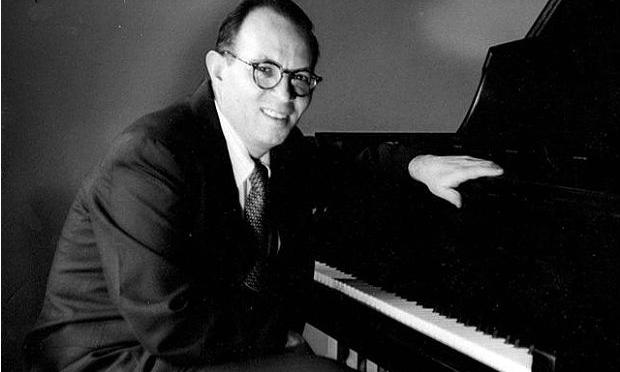
Susanna and Jerome Moss @ 1944
 
7 - Your father wrote ballets, a symphony, film scores, Broadway musicals and more. Much of his work is longer form and instrumental. Is there anything in "Stay with Me" that you feel is reflective of his work as a whole or is it atypical?
 
SMT:  "Stay With Me" is reflective of his work in that it is a beautiful melody.  He never gave up writing tonal music even though it wasn't in fashion during his prime years.  He believed there was always another tune to be written.


I'm fighting for my soul

Long Hard Times to Come ("Justified" theme) - Gangstagrass

"There are only two types of music: good and bad."

This famous quote is usually attributed to Duke Ellington or Louis Armstrong, but occasionally to others.  What matters most is that it's true.  The songs I choose to feature on this blog all fall into my personal definition of "good" - which means anything from 1970s bubblegum pop to a country song from the 40s, a just-released alternative tune or an instrumental version of something written centuries ago.  My tastes are broad, though I do tend toward melodic songs and interesting harmony.

"Long Hard Times to Come" falls into a few very interesting categories besides "good music."  First off, it's a television theme song, a genre which encompasses a wide range of music over the last 60 years.  Funny, but it seems the best shows often have the best songs - or maybe it's a Pavlovian process whereby we associate something we hear repeatedly (the song) with something that gives us pleasure (the program).  

"Justified" is one of the best dramas on television, up there with "Breaking Bad" and "Mad Men."  Each episode starts with an compelling cold open, leading to a dramatic moment and then, satisfyingly, the THUMP... THUMP... THUMP of a bass drum that kicks off "Long Hard Times to Come." 

Besides being a theme song, LHTTC is distinct because it sounds fresh - it's a blend of bluegrass and hip hop.  Certainly a polarizing genre - some people don't like it at all.  But many more do.  If you haven't heard it, take a listen to the full version of the song and decide for yourself:


Long Hard Times to Come


After the jump, Rench, the singer/producer/songwriter behind Gangstagrass, answers seven questions about "LHTTC."