Days Upon Days

"We'll Never Have Paris" Soundtrack - Alexis + Sam

I recently had the chance to see a romantic comedy, "We'll Never Have Paris," which featured a very enjoyable soundtrack consisting of two major elements: vintage French pop songs and a score which struck all the right notes (pun intended).
 

Before I say more about WNHP, let me opine that there are, generally speaking, three kinds of film scores:
 
1 - Big and bold and unforgettable: Star Wars, Gone With the Wind, Psycho.  This style works best with certain types of films: epics and action and horror.
 
2 - Annoying music that calls attention to itself and distracts you from the story taking place on screen.  Scores that underline every emotion to tell you FEEL SAD! LAUGH! JUMP!  I tend to block these from my memory, but I seem to recall "Amistad" being an example of such.
 
3 - Scores that you don't notice because they do such an artistic job of organically fitting the plot, characters, cinematography and editing.  They subtly tie things together and draw out emotional nuances without you being consciously aware of it - unless you direct your focus on the music itself.
 
The score to WNHP belongs to that third category, which is fitting for a breezy love story.  After I got home from the screening, I looked up the credits and found that the score had been written and recorded by Alexis Marsh and Samuel Jones, a duo based here in Los Angeles. 
 

Alexis on tambourine
Sam and Jonathan Richards


They were kind enough to answer the seven questions I sent them.

1 - How did you two get chosen to do the score for the film?
 
Alexis + Sam:  In 2011 we were referred by Evan Schroedek, a fantastic editor, to Jocelyn for her first feature, "I Am I."  Sam scored one of Evan's USC projects, and we kept in touch with him after graduation.  One day we got an email saying he was working on a film he thought we'd be good for so we sent him a folder of music and waited.
 
It was about 3 or 4 months till we got a call from one of the producers, Cora Olsen, asking if we'd like to see a cut of "I Am I."  We watched it; Alexis cried her head off; we wanted to write the music for the film.
 
We met with the Present Pictures folks - Cora Olsen, Jen Dubin - as well as Jocelyn Towne, the director, and her husband, Simon Helberg, an executive producer and actor in the film.  A week later we got their call letting us know they'd like us to be on the team.  We were in the Home Depot parking lot at the time.  So damn excited. 
Anyway, we spent the fall of 2011 working on the score to "I Am I" with that same group.  It was our first feature.  We loved the film; we loved the people.  So when they started working on "We'll Never Have Paris" we hoped they'd call us for that score.  Jocelyn texted us in the fall of 2013 on the way back from the shoot in Paris to see if we were interested and available. 

2 - "Days upon Days," the song you wrote for the film -  did you worry about how it would fit with all the older French pop songs used elsewhere in the film?
 
A+S:  "Days Upon Days," was a song we had written and produced before we started work on "We'll Never Have Paris."  They needed a song to play in the background for the Brooklyn pizza restaurant scene, and it just seemed to fit.
 
There are a couple versions of that song - one using synthesizers for the lead and rhythm lines, and the other using gritty guitars.  It was fun to work within those two sounds.  They wanted the rock guitar version. 

I think there was a bit of worry about the song being good enough to sit with those classic French pop tunes.  Not because it wasn't French - just did it pale in comparison to such fantastic recordings/compositions/performances?  But that kind of thinking will destroy you so we focused on making the best recording we could and let it be what it was. 

3 - Will there be a soundtrack album, given that most films' scores are not released (especially on CD/vinyl) due to the current economics of the music industry?
 
A+S:  We are currently working out the details for a soundtrack of our work on the film: the score cues, "Days Upon Days." A record would be a dream though it'll most likely be an iTunes release only. 

4 - Did you use any scores from other films as inspiration for this one?
 
A+S:  In our initial conversations about the film with the directors, Jocelyn and Simon, the reference that kept coming up was Henry Mancini - his score for "The Pink Panther" ("A Shot in the Dark," the "Inspector Clouseau Theme"), the "Baby Elephant Walk" from "Hatari!," "A Profound Gas" from "Peter Gunn."
 
Those brilliant melodies create such a sense of character without picture.  That was a big inspiration.
 
Rolfe Kent's score for "Sideways" was a great reference for how jazz could be used in a contemporary film - tricky to balance that style without hitting elements on screen too hard ('over-scoring' being the word we try to avoid in potential criticisms of our scores).  We were fascinated to see how it could just play under dialogue, for entire scenes at times, without distracting from what was happening in the film.  That film and score just work together, and tied into Miles' (Paul Giamatti) character/story perfectly. 
 
And finally, our favorite reference: Eric Dolphy's "Out To Lunch" for Quinn's unravelling scenes.  That was really a dream come true for Sam - to have that in the vocabulary.  Simon and Jocelyn both have incredible taste in music so finding the sound was a great education in how all these references could come together - to try to do our own version of that.

5 - Where did you fit in the process - did you start composing after the film was far along in editing or were you involved earlier?
 
A+S:  We started working out some themes and a few sketches of cues toward the end of the editing process when they had a rough cut that was close enough to work with, but the bulk of it was in the month between picture lock and final mix. 
 
6 - What is your process like, working as a team, and was this score pretty typical in that regard?
 
A+S:  Our work begins with a lot of discussion about the tone, palette, and concept of the score, followed by the two of us writing separately - each coming up with a number of themes or sketches that we perform, record, and produce to present to the director(s) & producer(s). 
 
Once we have an idea of what is working for the team (which melodies, instruments, or sounds they like), there is a process of sending things back and forth, adding or subtracting elements, altering forms and arrangements, etc. so that each cue becomes a collaboration that works with the picture.
 
Simon and Jocelyn came to our studio on a weekly basis for about a month, going over the latest reel, talking about what was working, suggesting various ideas/experiments for what wasn't working yet.  About a week before the final mix, we had some of our favorite jazz musicians come in and play over the cues as well as a small string section for a few cues toward the end of the film.

Louis Cole
Nick Mancini
Ron Stout


7 - The two main male characters have a bit of a musical rivalry going on, piano versus violin.  Did that inform or affect your work in any way?
 
A+S:  Quinn's being a jazz piano player certainly set out a precedent for having piano featured in the score. We loved what they did with Guillame's character - the Mozart jokes, the Boulez reference, the way he plays violin for Devon's grandparents. He's a fraction of the story compared to the larger history that Devon and Quinn have so there weren't many opportunities to bring that piano/violin tension through literally with the score.

A Big Mac on my Breath

JUNK FOOD JUNKIE - LARRY GROCE

The day after Christmas, I took my guitar to McCabe's in Santa Monica for repairs.  While perusing the musical equipment for fun, I saw this on the wall beneath some mandolins:


My photo's a bit blurry, but what is shows is a framed copy of Larry Groce's #9 single from 1976, "Junk Food Junkie," along with a note stating that the single had been recorded at McCabe's, which in addition to selling and repairing guitars also hosts intimate concerts.

That piqued my curiosity - why was it recorded there?

But before we get to that, let me ask you a question:

How many people write and record a Top Ten single AND put out two platinum record and six gold records of children's music for Disney AND serve as artistic director/host/co-founder of one of the country's best live music shows for thirty years?


Probably just one person, Larry Groce.

The Top Ten single is "Junk Food Junkie," obviously.

The Disney records include the Grammy nominee "Winnie-the-Pooh for President" as well as four volumes of "Children's Favorite Songs."

The live music series is NPR's "Mountain Stage," which has been presenting an impressive variety of top notch musicians since 1983.  I assume you're familiar with this radio institution, but if not, please click the hyperlink and dig in. 

Here's Larry performing "Junk Food Junkie" on "Mountain Stage."  Then we get the answer to "why was the single recorded at McCabe's" and more.


1 - Why did you record this at McCabes instead of in a studio or some other performing space? 

LARRY GROCE:  McCabe's recorded my performance there without telling me. When we (me and my manager at the time) found out about the recording we asked to hear it and get a copy. A little later we decided to make the performance into a recording. A studio version wouldn't have worked. 


2 - These days, are you more Mr. Natural or more Junk Food Junkie?

LG:  Still half and half. 

3 - Where did Peter Alsop, who was the first person to record JFJ, hear your song?

LG:  Peter was a friend. I don't think his recording was released before my original independent version in 1975 on my former manager/producer's label. The Warner-Curb release wasn't until 1976. 

4 - I read that Berke McKelvey played fretless bass on the track; true?

LG:  I don't think Berke played on that recording. The bass and drums were overdubbed and I forget who played them - I wasn't at that overdub session. I was playing solo at McCabe's when it was recorded. However, Berke did play with me most of the time back then. He plays with Chandler Travis now and teaches at Berklee.

5 - Why do you think that satirical songs have seemingly disappeared from pop culture?

LG:  I don't think satire and novelty material has disappeared, it just switched from sound recordings to YouTube videos.

6 - Did you watch the Jackson Five sing JFJ with McKenzie Phillips on their television show?

LG:  I didn't see it live but got a video of it. A lot of people supposedly performed the song in different ways: Dinah Shore on her TV show, Marilyn McCoo and Billy Davis Jr. (of the Fifth Dimension) in their club act, Judy Collins with the Boston Pops and several more. I'd liked to have seen how they all did it, it's such an odd song.


The Jacksons & Mckenzie Phillips - Junk Food... by choucoune92

7 - What do you recall of your appearance on the Tonight Show?

LG:  I just remember that it was a high pressure show and they acted like it was the most important thing in the world so don't screw up.

I had met Dick Cavett on the Merv Griffin show and remembered reading in his bio that the first time he walked on stage at the Tonight Show he could see himself walking onto the TV at his aunt's house in Nebraska. It was like that. I was nervous but got through it.

Joan Rivers was guest host. My teenage sister had flown out from Dallas to see it and we got a laugh when Joan, who had never met me and did not meet me that day, either, opened the show saying that everyone on the show were her good friends. Welcome to show business.


Where No Doctor Can Relieve Me

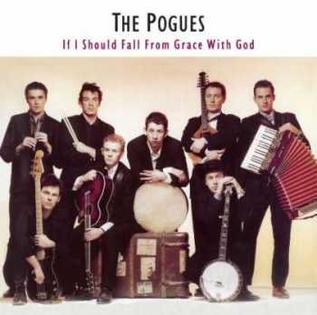
"If I Should Fall From Grace With God" - The Pogues' James Fearnley


While on a long drive recently, I stumbled across a compelling interview on NPR.  The fascinating fellow telling tales of rock and roll turned out to be James Fearnley, accordion player for and founding member of The Pogues.  It turns out that earlier this year his book "Here Comes Everybody: The Story of the Pogues" was published.  Believe me, if you heard the interview, you wanted to get the book as soon as possible.

I don't recall the first time I heard the Pogues, but very few people I knew were aware of the band. They were much bigger in the UK than they were in America.  But I was drawn to their unique blend of rock, celtic, punk and world music.  Their recordings from the late 1980s and early '90s have held up very well as a result of following their own muse and incorporating traditional elements, rather than chasing whatever sound was au courant.

I reached out to James and he kindly agreed to answer my questions.  The hard part was picking which song would be the subject.  "Fairytale of NY" gradually became a favorite of the musically hip here in the US; it's a Christmas song and this is the holiday season; and I find the song completely amazing even after many hundreds of listens.  But it felt like well-trod ground.

So I chose "If I Should Fall From Grace With God," the single that followed "Fairytale," for its mix of infectuous music and dark lyrics.  Take a listen; the Q+A follows.

IF I SHOULD FALL FROM GRACE WITH GOD - THE POGUES

1 - Do you recall your impression of "If I Should Fall From Grace With God" in whatever state it was in when Shane (McGowan) first played it for you?

James Fearnley:  It was during rehearsals in January 1987 that I first heard ‘If I Should Fall From Grace With God’, along with ‘Rake at the Gates of Hell’, both of which he would probably have written anyway, but each earmarked for inclusion in the soundtrack for Alex Cox’s film, ‘Straight To Hell’, which had been shot, in Spain, the previous summer. 

Both songs, musically speaking - the way we went about them anyway - relied on a kind of propulsive, swampy (aptly enough for the choruses of ‘If I Should Fall From Grace With God’, with their images of rivers and mud), Mississipi Delta shuffle, with elements of Cajun music, even though the band hadn’t actually visited the South at that time. 

Both songs seemed fairly complete by the time Shane introduced them to us, structurally. I had always enjoyed the powerful statement of a melody which could basically stand alone, reiterated in the middle, and as a finale to the song, following the sort of template the Pogues, in conjunction with Shane’s songwriting, had developed in the course of the previous couple of years, and as early as ‘Streams of Whiskey’ and ‘The Dark Streets of London’. 

I’ve written about the opening melody of ‘If I Should Fall From Grace With God’ in ‘Here Comes Everybody’, and how it bore similarities, for me, to ‘The Bonny Banks of Loch Lomond’. I remember adoring the melody - it’s pentatonic scale expansive and ancient, and carrying with it the theme, as in ’The Bonny Banks of Loch Lomond’, of the proximity of death. I wouldn’t have acknowledged, at the time, the narrator’s beseeching ‘Let me go, let me go’, to have been particularly significant, as such appeals became more urgent a couple of years later.

2 - You played a variety of instruments on the IISFFGWG album - grand piano on "Fairytale of New York," a mandolin, a dulcimer which you hammered with teaspoons, etc.  Did you play anything in addition to accordion on the title track? 

JF:  Recording studios have always been a toy box for me, particularly during the recording of 'If I Should Fall From Grace With God’, with Steve Lillywhite in May 1987, and particularly on ‘Fiesta’, when it came to replicating gunshots by means of my mouth, among other things. A few years before, I’d spent quite a long period listening to Spike Jones and His City Slickers. I used to know the drummer from a band called the Vibrators. We’d get the saucepans and lids out from my kitchen, and a couple of spoons each, and 'play' along with dance bands from the 1930s - Ray Noble and Al Bowlly were favourites. 

When it came time to record the demos for a large part of what turned out to be the album 'If I Should Fall From Grace With God’ (’The Terry Woods Solo Album’, which, for ‘contractual reasons’ had to be kept secret), for ‘Fiesta’ there were metal ashtrays and other similar percussion instruments around the penthouse studio at Abbey Road. Otherwise, I remember sawing away at a cello on ‘Turkish Song of the Damned’, and being summoned to the studio by Lillywhite to add a bit of ‘sizzle’ to ‘Bottle of Smoke’, by means of a cymbal laid flat on the floor and beating out triplets on it with sticks. 

I think the hammered dulcimer came later, once I’d realised there was an instrument that sounded better than laying a mandolin on my lap, damping off the strings I didn’t want by means of cardboard stuck between them, and laying into it with teaspoons. The break in ‘Haunted’ (to Philip Chevron’s chagrin, because I rather think he would have liked the opportunity to play a guitar solo), which we recorded a year earlier, is done that way.

3 - Why did the band choose to name the album after this track?

JF:  Frank Murray, our manager, was vexed that we hadn’t come up with an album title. ‘Red Roses For Me’ had come so immediately and simply. I wonder if Shane knew all along what he wanted the title of our first album to be. ‘Rum Sodomy and the Lash’ became obvious, from Andrew Ranken’s navy stories - though I’m glad the album wasn’t called ‘Dance of the Flaming Arseholes’, which was one of Andrew’s most memorable stories. ‘If I Should Fall From Grace With God’ proved to be not so easy. Nothing ever spontaneously raised its head. Murray, with his back against some sort of wall, burst into our rehearsal, wanting an album title. Shane just shouted back "‘If I Should Fall From Grace With God’!”  to make him go away.


4 - IISFFGWG was used in a 2010 Subaru commercial about hockey moms.  Could you ever have envisioned this back in 1988?

JF:  No. Neither could Iggy Pop have envisioned ‘Lust for Life’ in a commercial for Royal Caribbean cruises.

5 - An earlier, slower version of IISFFGWG was released on the soundtrack for "Straight to Hell" in 1987.  Why did the band decide to revisit/redo the song?

JF:  There’s no gripping story to this. The song, with ‘Rake at the Gates of Hell’, was recorded for the ‘Straight to Hell’ soundtrack. There was some foot-dragging on our part, vis à vis our relationship with Stiff Records, and we were eager to record. After our summer holidays in the Tabernas Desert outside Almerìa there was a lot of energy in the band, musically. ‘If I Should Fall From Grace With God’ and ‘Rake at the Gates of Hell’ were part of that energy. ‘Rake at the Gates of Hell’ should have been a contender for the record had it not been for the malevolence of the lyrics. Shame.

6 - How disappointed were you, or not, when IISFFGWG peaked at #58 in the UK after the previous single, "Fairytale of NY," was a #2 hit? 

JF:  ‘Fairytale of New York’ hit a nerve that was always going to remain hidden from ‘If I Should Fall From Grace With God’, I suppose. Christmas in the United Kingdom (in perpetuity, it seems) was ready for ‘Fairytale of New York’. Easter not so much for ‘If I Should Fall From Grace With God’. (I think I’m right in saying that the single of ‘If I Should Fall From Grace With God’ was released around Easter 1988.)

7 - What is your most memorable live performance of IISFFGWG?

JF:  All performances of ‘If I Should Fall From Grace With God’ have tended to run into one collective one. It has been a favourite of mine to play, since we first started playing it. It provides me one of the first opportunities in the set to throw the bass end of the accordion skyward and drag the keyboard end down towards me for the last chord. If there’s any performance or series of performances I particularly remember, they were for the video we recorded at the Town and Country in Kentish Town during the week of St Patrick’s Day 1988. Philip Chevron was masterful in front of the cameras. I had no idea what to do and learned a lot from him. Not much of a memory, it’s true, since it forms part of that residency we had, and in our stamping ground, in our home town, at the end of a tour of the UK, not long after coming back from the other side of the world after our first tour of Australia. It was good to be back at home.


For other interviews James has done, see the links at this page on his website.